
Concrete Driveway Grades and Thickness: What Perth Homes Actually Need in 2026
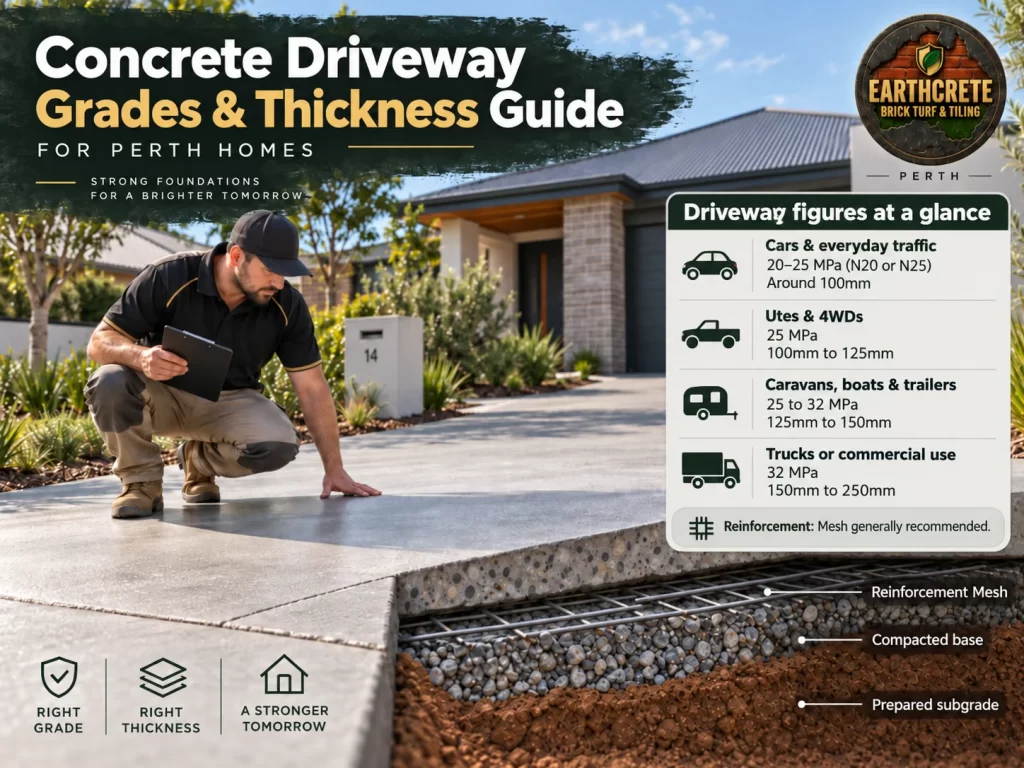
Table of Contents
If you’re comparing concrete driveway quotes in Perth, the grade and thickness can make the numbers confusing. One quote may specify 100mm of N25 concrete, while another recommends a thicker slab or a higher MPa rating. So which one is right? It depends on the vehicles using the driveway, the ground beneath it, reinforcement, drainage and site conditions. Getting these details right matters because a durable driveway starts well below the finished surface.
In this guide, we discuss what Perth homeowners should know about concrete grades, thickness, installation and cost before choosing a quote.
What Does Concrete Grade Actually Mean?
Grade refers to how much load concrete can carry once it has cured, measured in megapascals, or MPa. Think of it as a strength rating. The higher the number, the more pressure the concrete can take before it fails.
For a standard home driveway carrying cars and everyday traffic, a 20 to 25 MPa mix, often labelled N20 or N25, is the usual starting point. Where a driveway regularly carries something heavier, such as a loaded ute, a caravan, or a boat on a trailer, many concreters step up to a 32 MPa mix for extra margin.
Concrete with a higher grade costs more, mostly because it uses more cement per cubic metre. But grade alone is not the full picture.
One of the most common misunderstandings homeowners run into is assuming that paying for stronger concrete means everything else can be scaled back. It cannot, and that is exactly what the next two sections cover.
For more detail on mix design and residential slab specifications, Cement Concrete & Aggregates Australia publishes industry guidance on concrete construction that is worth reading if you want the technical detail behind these figures.
How Thick Should a Concrete Driveway Be?
Thickness is usually the second number on a quote, and it works alongside grade rather than replacing it. A typical passenger vehicle driveway in Perth runs around 100mm.
Where the driveway carries heavier or more frequent loads, such as trucks, caravans, or boats on trailers, thickness commonly increases to somewhere between 125mm and 150mm, often paired with reinforcement mesh.
Reinforcement does not replace thickness, but it changes how the slab behaves under stress. Steel mesh, placed through the middle of the slab rather than sitting underneath it, helps hold hairline cracks together as the concrete naturally shrinks and moves, instead of letting them widen into a real problem.
It is worth including on any driveway under regular heavy loads, and it is standard practice on most residential jobs regardless. Local councils can also set minimum standards for driveways, and separately, for the crossover section connecting your property to the road. More on that shortly.
Grade and Thickness Solve Different Problems
This is where a lot of driveway advice gets muddled, so it is worth being direct about it. Concrete grade and slab thickness are not interchangeable, and one cannot substitute for the other.
- Grade affects how much compressive strength the concrete itself has.
- Thickness affects how the slab spreads and distributes load across its area.
- Reinforcement affects how the slab handles cracking and movement over time.
- What sits underneath the slab affects whether any of the above holds up at all.
A stronger mix poured at an inadequate thickness, on a poorly prepared base, will still crack. A thick slab poured with the wrong grade of concrete will not perform properly either.
A driveway that holds up for decades comes from getting all four of these right together, not from treating one figure as the fix for everything else.
Concrete Driveway Grade and Thickness at a Glance
The table below brings the last two sections together as a quick reference. Treat it as a starting point rather than a final specification, since your site conditions can still change what is actually recommended.
Vehicle use | Typical grade | Typical thickness | Reinforcement |
Cars and everyday traffic | 20 to 25 MPa (N20 or N25) | Around 100mm | Mesh generally recommended |
Utes, four-wheel drives | 25 MPa | 100mm to 125mm | Mesh recommended |
Caravans, boats, trailers | 25 to 32 MPa | 125mm to 150mm | Mesh or bar reinforcement |
Trucks or commercial use | 32 MPa | 150mm to 250mm | Bar reinforcement, engineer-designed where required |
Why Perth Ground Conditions Change the Answer
This is the part general driveway advice usually skips, and it matters more here than people expect.
Much of Perth sits on sand, which drains well and is generally forgiving to build on. Plenty of suburbs, particularly across the eastern and southern corridors, sit on reactive clay instead.
Clay expands when it is wet through winter and shrinks back during a dry summer. That movement pushes and pulls at whatever is sitting on top of it. A driveway with a thin or poorly compacted layer underneath will show it, usually as diagonal cracking from the corners, or a slab that lifts unevenly over time.
The fix is not simply a thicker slab. It comes down to proper excavation and site preparation, with a well-compacted layer beneath the concrete, so the slab isn’t sitting directly on ground that shifts with the seasons.
This is also why a proper site visit matters more than a quote given over the phone. Nobody can tell you what your driveway needs underneath it without actually seeing the soil. If a quote doesn’t mention this kind of preparation at all, ask about it before you accept it.
The Concrete Driveway Installation Process
Concreting a driveway is a sequence, not just a pour. Roughly, it goes like this.
- Site assessment. Measuring the area, checking levels, access and existing drainage.
- Excavation. Removing topsoil and unsuitable material down to the required depth.
- Ground preparation. Laying and compacting a solid layer, which is where a lot of long-term durability is actually decided.
- Formwork. Setting the boundary forms that shape and level the slab.
- Reinforcement. Placing mesh or bar reinforcement where the design calls for it.
- Pouring and finishing. Placing the concrete, screeding it level, and applying the surface finish while it is still workable.
- Curing. Protecting the surface while it gains strength, keeping vehicles off for about a week and holding off on heavier loads for closer to a month.
Rushing any of these steps, especially the ground work and curing time, is where most premature driveway failures start, no matter what grade or thickness was written on the quote.
EarthCrete’s concrete driveway installation work follows this same process on every job, from site preparation through to the final finish.
What Affects Concrete Driveway Price
Concrete driveway price in Perth comes down to several variables working together, rather than one flat rate per square metre.
- Size: Total area scales both material and labour, though larger driveways often work out cheaper per square metre than small ones, since fixed costs like site setup and formwork are spread across more area.
- Grade and thickness: A driveway built to a higher specification for heavier vehicles costs more than a standard passenger driveway.
- Site preparation: Sloped blocks, tricky access, or poor ground conditions all add work before any concrete goes down.
- Removing an existing driveway: If you are replacing an old slab rather than pouring on a clear site, demolition and disposal are added on top of the new installation.
- Finish: A plain broom finish sits at the lower end. Exposed aggregate, coloured or stencilled finishes cost more.
- Drainage and crossover work: Extra site work where council crossover requirements apply.
Because these variables interact, the cost to install a concrete driveway in Perth is genuinely specific to the property rather than a single number that applies to every job.
Anyone quoting a fixed figure before concreting has even been discussed on site is skipping a step. A proper site visit and an itemised quote are the only reliable way to get a real number for your driveway.
What to Check Before You Accept a Quote
Before signing off on anything, check the quote actually specifies the following.
- Concrete grade, slab thickness and reinforcement type
- Ground preparation and excavation depth
- Finish type and control joints
- Removal of any existing surface, and whether crossover or drainage work is included
If one quote is noticeably cheaper than the others, this list is usually where the difference is hiding, most often in the work done underneath the slab, since it is invisible once the job is finished.
It is also worth checking with your local council early, since driveway and crossover requirements can differ between Perth councils. Confirming this before work starts avoids costly rework later.
Choosing a Finish for Your Driveway and Concrete Slab
Once grade, thickness and preparation are sorted, the finish is where personal choice comes in.
A plain broom finish is the simplest and most budget-friendly option. Exposed aggregate reveals the stone within the mix for a more textured, decorative look. Coloured or stencilled finishes are also available depending on the style of your home.
None of these choices changes the structural grade or thickness your driveway needs. That is decided by load and ground conditions, not appearance. Finish really is the last decision in the process, once the technical side is settled.
Get Your Concrete Driveway Specification Right with EarthCrete
The right grade and thickness for your driveway comes down to your soil, your vehicles and your block, not a generic figure from a blog post. EarthCrete Brick assesses Perth properties in person before recommending a specification.
Request a free quote to get started.
FAQs
Does a higher concrete grade mean the slab can be thinner?
Not on its own. Grade affects the concrete’s strength, but thickness is what lets the slab spread load across its surface. A higher grade at an inadequate thickness is still prone to cracking under load.
Do I need council approval for a new driveway in Perth?
It depends on your local council and whether the work includes the crossover connecting your driveway to the road. Requirements vary between councils across the Perth metro area, so it is worth checking with yours before work begins rather than assuming one rule applies everywhere.
How long before I can use a new concrete driveway?
Most driveways handle foot traffic within a couple of days and light vehicles after about a week. Full strength takes closer to a month, which is when heavier vehicles like caravans or trailers should first be parked on it.
Why do driveway quotes vary so much for the same job?
Differences usually come down to groundwork, reinforcement and site preparation rather than the concrete itself. Two quotes with the same square metre rate can still involve very different amounts of work underneath.